People's Open Bible

Partnerships for seminaries & research teams

Put the source trail in every student's hands.

People's Open Bible connects manuscript evidence, translation decisions, and public revision history—so a class can study Scripture with the reasoning in view.

Start with one course or one research question.

Evidence deskActs 20:37
01 Source witness
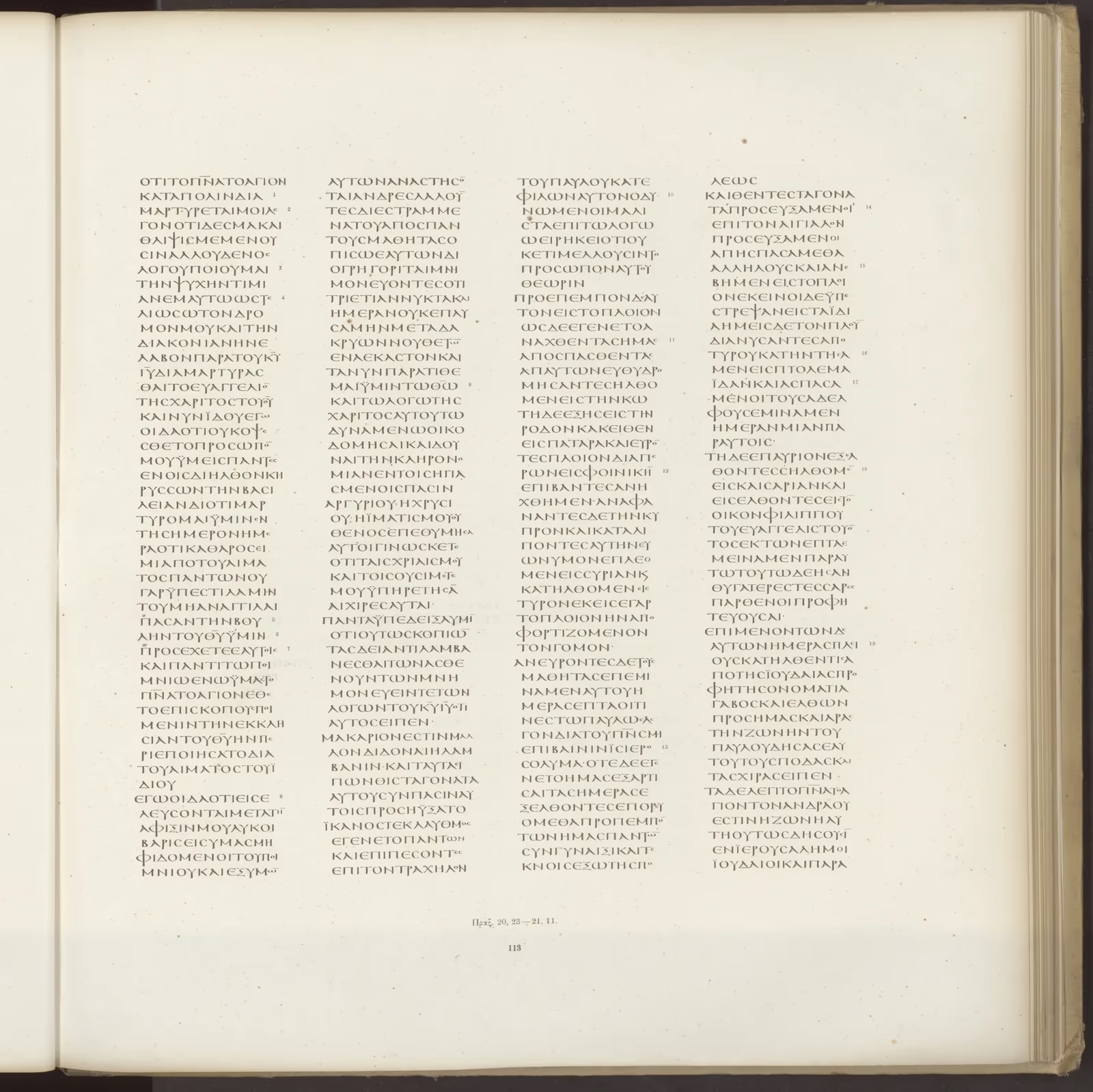
Public-domain 1867 photographic facsimile of Codex Sinaiticus containing Acts 20:23 through 21:11
Codex Sinaiticus facsimile · Acts 20:23–21:11View source ↗

02 Rendering decision

ἐπιπεσόντες ἐπὶ τὸν τράχηλον τοῦ Παύλου κατεφίλουν αὐτόν

“They all wept a great deal, threw their arms around Paul's neck, and kept kissing him.”

03 Public revision record
Beforefalling on Paul's neck
Afterthrew their arms around Paul's neck
Original-language sources

See the witnesses behind the text.

Public revision history

Review what changed and why.

Connected study tools

Move from a verse to its wider context.

Free student access

No paywall between a learner and Scripture.

One transparent workflow

One verse. The whole trail.

Students do not have to choose between clear reading and serious inquiry.
01

Source witness

Open the facsimile and the original-language text instead of taking the translation on trust.

02

Translation decision

Compare the chosen rendering with lexical alternatives and the reason for the choice.

03

Public record

Review the before, after, and rationale whenever a verse is revised.

04

Classroom discussion

Share the same evidence trail so students can examine it and reach informed conclusions.

What “source-aware” means here

Facsimiles are identified by witness and passage. Representative or reconstructed visuals are labeled as such, and they are never presented as textual proof.

An educator standing with a notebook and an open, welcoming gesture
Illustrative educator portraitGenerated for this page · not a testimonial

Built around the people in the room

Give the instructor proof. Give every student a path.

A serious study tool should strengthen the conversation, not replace it. The evidence stays inspectable so an educator can teach with clarity and a student can ask better questions.

01Shared starting pointEveryone sees the same passage.02Visible reasoningSource, decision, and revision stay together.03Instructor-led inquiryTechnology organizes the trail; people weigh it.
Bring this into a course

Choose a starting point

Fit the partnership to the work.

Begin small, name the outcome, and keep the evidence visible throughout.
Acts 20:37 · POB

They all wept a great deal, threw their arms around Paul's neck, and kept kissing him.

SourceAlternativesNotes

Classroom pilot

Try it in one course.

Put source-aware study in front of a real class without changing the rest of your curriculum.
  • A course-shaped onboarding plan
  • Free product access for students
  • A faculty review at the end
Plan a classroom pilot
Beforefalling on Paul's neck
Afterthrew their arms around Paul's neck

Research collaboration

Examine the text together.

Focus on a passage, translation question, or research theme and make the reasoning inspectable.
  • Shared source and decision review
  • A public path for proposed revisions
  • Clear attribution for accepted work
Discuss a research project
ReaderACTS 20
AtlasFELLOWSHIP
RecordREV. 15

Institutional integration

Connect the work you use.

Map the reader, Concept Atlas, and public record into the learning environment you already have.
  • Start with your existing workflow
  • Scope what works now and what needs building
  • Keep the source trail visible
Scope an integration

A bounded first step

A practical three-step pilot.

The institution scopes the service; students continue to access the public Bible for free.
1
30 minutes

Scope the course

Name the course, the passage or learning goal, and what success should look like.

2
30 days

Run the pilot

Give the class a focused entry point and collect the questions the evidence trail surfaces.

3
45 minutes

Review the evidence

Review what helped, what did not, and whether a deeper partnership makes sense.

Begin a conversation

Tell us what you're teaching.

Share a course, research question, or integration idea. We'll use it to shape the first conversation.support@cartha.ai Prefer email? Write directly and include your institution and goal.
Partnership inquirySent securely to the Cartha team.
Your inquiry is saved for the Cartha team. You can also email support@cartha.ai.